In modern manufacturing, the performance of an individual CNC machine is no longer the only factor that matters. What is increasingly important is the efficiency of the entire machine tool fleet. Machines can lose a significant amount of available production time due to workpiece changes, setup operations, waiting for an operator or poorly coordinated production planning.
By using a Flexible Manufacturing Concept (FMC) together with a centralized JMS (Job Management System), machines, robots, workholding systems and production orders can be connected into one coordinated manufacturing system.
The goal of this approach is to make better use of existing equipment, reduce downtime and increase production flexibility.
Four pillars of flexible manufacturing
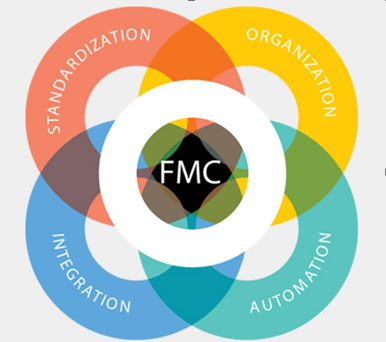
The FMC concept is based on four interconnected areas:
- standardization of workholding systems and pallets,
- organization of information and production processes,
- automation of CNC machine tending,
- integration and coordinated operation of the entire machine tool fleet.
It is important that automation is not viewed simply as adding a robot to an individual machine. The entire production process should be organized so that it can quickly adapt to different orders and changing production requirements.
Standardized workholding as the foundation
An important part of flexible manufacturing is the use of modular and standardized workholding systems. These include zero-point clamping systems, pallets, adapter pallets, grippers and various workpiece carriers.
Standardization allows workpieces to be prepared outside the CNC machine and enables fast, repeatable changeovers between individual production operations.
This reduces setup times and machine downtime. At the same time, the same workholding concept can be used across different machines and at different stages of the manufacturing process.
Centralized production management with JMS
As the number of machines and production orders increases, efficient information management becomes increasingly important.
The JMS system acts as a central platform for planning, scheduling and monitoring production jobs. It provides an overview of machine status, production orders and manufacturing progress.
For each part, the required production process can be defined, while the system can assign individual jobs to available machines that meet the required conditions for each operation.
Production is therefore no longer planned around a single machine. Instead, the available capacity of the entire machine tool fleet can be used in a more coordinated way.
Automated CNC machine tending
The next step is robotic automation. A robot can load and unload workpieces or pallets and serve one or several machines.
This enables CNC machines to operate independently for longer periods and reduces the need for manual machine tending.
Particularly interesting is the automation of an entire machine tool fleet, where one robotic system connects several different machine tools. Depending on the production process, an individual workpiece can move between different machines and manufacturing operations.
From an automated machine to an automated workshop
In conventional automation, the focus is usually on a single CNC machine, with the robot primarily responsible for loading and unloading that machine.
Centrally managed automation extends this concept across the entire machine tool fleet. JMS coordinates production jobs, robotic systems handle transport and workpiece changes, while CNC machines perform the individual manufacturing operations.
The system can also be connected to higher-level information systems such as ERP.
This creates a connected production structure:
ERP → JMS → automation → CNC machines
Such an approach provides greater flexibility when production priorities change and gives a clearer overview of the entire manufacturing process.
Better machine utilization and higher OEE
One of the key indicators of manufacturing equipment efficiency is OEE (Overall Equipment Effectiveness).
OEE is influenced by machine availability, performance and production quality.
Automation and centralized production management can reduce the amount of time machines spend waiting for workpieces or operators. Better organization of production jobs also helps reduce unnecessary interruptions and improves the use of available capacity.
Real-time production monitoring also makes it easier to identify bottlenecks and other issues within the manufacturing process.
Who is this type of solution for?
FMC and centralized production management are not limited to high-volume manufacturing.
This approach can be particularly valuable for companies producing small and medium batches with a high variety of parts. In these environments, production requirements change frequently, making flexibility and fast production scheduling especially important.
The solutions are suitable for a wide range of manufacturing environments, including toolmaking, precision machining, the automotive and aerospace industries, medical manufacturing and subcontract production.
They are also well suited to companies producing prototypes or customized components and dealing with a wide variety of production jobs on a daily basis.
Gradual automation of the machine tool fleet
Optimizing a machine tool fleet does not need to happen in a single step. One of the main advantages of a modular approach is that the system can be developed gradually.
The first step may be the standardization of workholding and the organization of production processes. This can be followed by the automation of an individual CNC machine or production cell. Later, additional machines can be connected and centralized production management can be introduced.
In this way, automation can grow together with the needs of the company and gradually connect an increasing share of the production environment.
From individual machines to connected manufacturing
Optimizing a machine tool fleet means more than simply purchasing a faster machine or adding a robot. The greatest potential lies in connecting machines, automation, workholding systems and production information into one coordinated manufacturing process.
The Flexible Manufacturing Concept (FMC) and JMS enable better production visibility, more efficient use of available capacity and faster adaptation to changing production orders.
The result is a machine tool fleet that can operate in a more connected, flexible and efficient way, while making better use of existing manufacturing capacity.